
New, more effective treatments are urgently needed for the more than one million people living with Parkinson’s in Europe today. While there are therapies available for the condition, they do not improve all symptoms, nor do they slow or prevent disease progression over time, and long-term treatment is associated with adverse side effects.
PD-MitoQUANT (www.pdmitoquant.eu) is an Innovative Medicines Initiative (IMI – www.imi.europa.eu) research project that will improve our understanding of Parkinson’s so that better treatments can be developed in the future. The project will run for 3 years, starting from 01 February 2019, receiving 4.5 million euro in funding from the EU’s Horizon 2020 programme and 2.46 million euro in-kind from European Federation of Pharmaceutical Industries and Associations (EFPIA) members and Parkinson’s UK.
Researchers already know that neurodegenerative diseases, like Parkinson’s, damage cells in our brain. PD-MitoQUANT focuses on how mitochondria, the ‘powerhouses’ of the cell, contribute to cell death and neurodegeneration when they malfunction. There is growing evidence that mitochondrial dysfunction is involved in Parkinson’s, but no effective treatments have been developed based on this knowledge. PD-MitoQUANT will deepen our understanding of precisely how mitochondria malfunction in Parkinson’s, and develop improved tools for the early stages of drug development so pharmaceutical companies can develop better treatments in the future.
PD-MitoQUANT Coordinator, Prof. Jochen Prehn, RCSI said: “This project will join forces with top scientists in academia and industry to bring a fresh look on how we identify and test novel drugs for the treatment of this devastating movement disorder.”
The project involves 14 partners from 9 countries, including academic experts from RCSI (Royal College of Surgeons in Ireland) (www.rcsi.com), Institut du Cerveau et de la Moelle Epinière (https://icm-institute.org/), German Center for Neurodegenerative Diseases (https://www.dzne.de/), Neuroscience Institute of the National Research Council (https://www.cnr.it/), University College London (https://www.ucl.ac.uk/), Radboud University Nijmegen Medical Centre (www.radboudumc.nl), the Centre National de la Recherche Scientifique (CNRS, http://www.cnrs.fr/), SMEs (GeneXplain GmbH (http://genexplain.com/), Mimetas B.V. (https://mimetas.com/), Pintail Limited (www.pintail.eu), pharmaceutical companies from the EFPIA (https://www.efpia.eu/) members Teva Pharmaceutical Industries Ltd. (https://www.tevapharm.com/), H. Lundbeck A/S (Lundbeck, https://www.lundbeck.com/) and UCB S.A. (UCB, https://www.ucb.com/), and a patient advocacy organisation (Parkinson’s UK – https://www.parkinsons.org.uk/).
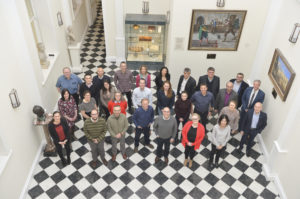
PD MitoQUANT Kick Off Meeting at RCSI, 123 St. Stephen’s Green, Dublin 2.
About PD-MitoQUANT www.pdmitoquant.eu
PD-MitoQUANT has received funding from the Innovative Medicines Initiative (www.imi.europa.eu) 2 Joint Undertaking under grant agreement No 821522. This Joint Undertaking receives support from the European Union’s Horizon 2020 research and innovation programme and EFPIA and Parkinson’s UK.
For more information on the projects, please click on the link below
Development of Novel Oligogenic ALS Models for Drug Discovery
Amyotrophic Lateral Sclerosis (ALS) is a fatal disease resulting in muscle weakness, paralysis and ultimately death, often within 2-3 years of symptom onset. These symptoms arise due to the loss of motor neurons from the brain and spinal cord. Treatment options are limited and have little impact on halting progression of the disease. This research project is aimed at developing and characterising new models of ALS that can be used to investigate how motor neurons degenerate in people living with ALS. We expect that this project will provide a foundation to highlight new drug targets for exploitation in future research.
* Principal Investigator/Researchers
PI: Prof. Jochen Prehn
* Disease Area
Amyotrophic Lateral Sclerosis/Motor Neuron Disease
* Field of Research
Neurodegeneration
* Institution
Royal College of Surgeons in Ireland
* Start year
2022
* Projected Completed: (either yes/no or projected finish date)
No, projected finish date 2
* Funding body
This research is supported in part by a research grant from Taighde Éireann – Research Ireland under Grant Number 21/RC/10294_P2 and co-funded under the European Union’s Horizon 2020 research and innovation programme under the Marie Skłodowska-Curie grant agreement No 101034252